When the Cinema Visit Became an Evening Out
When did a cinema visit become an evening out? Follow the shift from moving pictures as one public attraction to scheduled shows and mixed programmes.
When did the cinema visit become an evening out? The answer lies in how the screening was arranged: early moving pictures could appear as one attraction in a broader outing, while later theatre customs increasingly made a scheduled show or complete programme the reason to go out. These arrangements overlapped; there was no single changeover date that applied to every town or venue.
To describe the shift carefully, follow the evidence in a particular account: where the venue stood, whether it named a performance time, and what the programme offered. Together, those details show how a cinema visit could move from one stop in a public leisure circuit toward an occasion organized around entertainment inside the theatre.
From attraction to appointment
In early moving-picture exhibition, films could be presented in places devoted to several amusements or as one element within a larger public outing. A visitor might encounter a screening while already spending time in an entertainment district or at a venue offering other attractions. In that setting, the film did not necessarily determine when the outing began or what else the visitor did.
As dedicated theatres and regular schedules developed in different places, a posted showtime could make attendance more deliberate. The audience had a reason to arrive for a particular performance, and the venue could organize the screening as a distinct event. This was a change in emphasis, not a clean replacement: a scheduled show might still sit within a busy leisure district, and a theatre could still offer more than films.
So the historical progression is best described as overlapping practices. Moving pictures could be a diversion encountered during an outing; a fixed performance could make the theatre itself a destination; and a mixed bill could turn the visit into a planned evening of entertainment.
What shaped the visit
Three details help distinguish those arrangements without assuming that one pattern describes every audience:
- Setting: If a venue is described among fairs, shops, or other amusements, treat the screening as a possible part of a wider outing; if the account emphasizes a dedicated theatre, consider the venue itself as the destination.
- Timing: If a notice gives a start time or named performance, read the visit as organized around a show; if it gives no schedule, avoid assuming that attendance followed a fixed appointment.
- Programme: If the bill lists live music, spoken introductions, or other acts with films, describe a mixed entertainment occasion; if it lists only a screening, describe the film performance without adding unrecorded attractions.
- Audience movement: If a description says visitors could enter during ongoing entertainment, note the possibility of a more fluid visit; if it specifies a beginning and sequence, describe a more structured performance.
- Promotional language: If an advertisement presents the venue as one amusement among several, preserve that framing; if it promotes a particular show, explain how the show was made the focus.
- Local context: If a source identifies nearby leisure venues or a theatre’s regular programme, use that context to interpret the visit; if it gives neither, keep conclusions limited to the details it does provide.
Use the strongest clue available, and leave gaps in the record open rather than filling them with a familiar modern routine.
How did the shift work?
Did every town change at the same time?
No single timeline fits every place. Exhibition practices depended on local venues and entertainment customs, so describe the sequence shown by the source at hand rather than assigning one date to cinema-going as a whole.
Did a fixed showtime make films the whole evening?
Not necessarily. A schedule made the performance easier to plan around, but the theatre might still pair films with music or live acts, and the audience might combine the visit with other activities.
Could a theatre mix old and new customs?
Yes. A theatre could advertise a set performance while remaining part of a larger entertainment district, or combine a film with other attractions. The categories describe how a visit was organized, not mutually exclusive kinds of building.
What can an advertisement establish?
A notice can show what a venue promoted, such as a start time, film, or accompanying act. By itself, it cannot establish how every visitor behaved or whether the advertised format represented other theatres nearby.
Read a notice closely
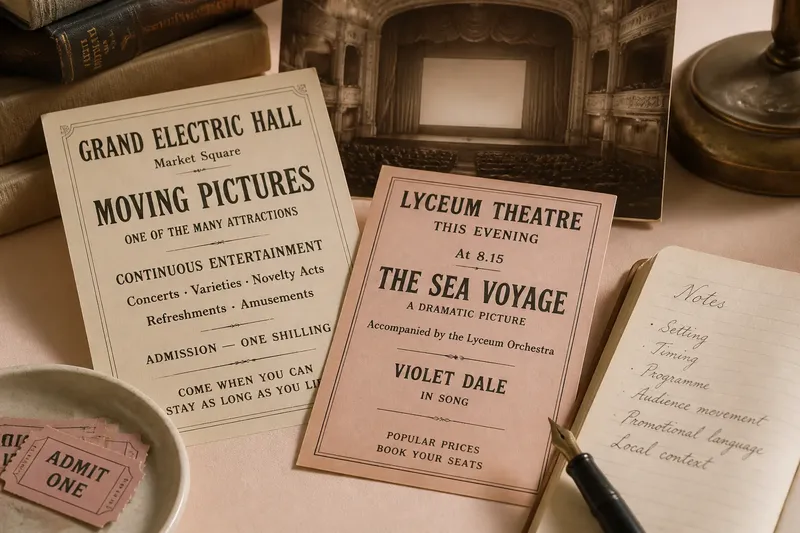
Imagine a fictional researcher comparing two invented notices. The first calls moving pictures one attraction in a public entertainment hall but gives no start time. The researcher records the venue’s wider setting and treats the screening as part of a broader outing, while leaving the audience’s arrival pattern unknown.
The second invented notice names a film, gives a performance time, and lists live music. The researcher describes it as a scheduled, mixed programme: the show organizes the visit, but the music makes it more than a film screening alone. The result is a clear comparison without claiming that either notice represents a whole period or region.
When you ask when the cinema visit became an evening out, look for this change in organization rather than a universal turning point. A cinema visit might be one stop on a public route, a timed appointment, or a varied performance occasion; sometimes it was more than one of these at once. For a sound account of cinema-going history, say which detail shaped the visit and which parts remain uncertain.