A Slow Look at a Cinema Interior
A slow look at a cinema interior helps you notice sightlines, aisle patterns and wall finishes during an ordinary visit, without leaving public areas.
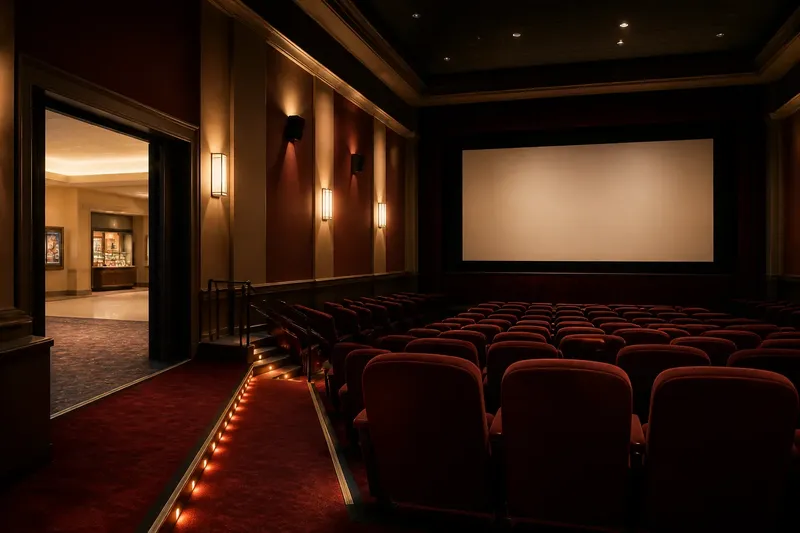
Where does your eye go when you enter a cinema auditorium: straight to the screen, along the aisle, or toward a patch of light on the wall? A slow look at a cinema interior turns an ordinary public visit into a close reading of how the room guides attention. Stay in visitor areas, keep moving when needed, and leave every fixture and piece of equipment untouched.
Begin at the threshold
Pause where the lobby opens toward the auditorium, if the entrance is clear and staff permit you to stop. Notice what changes first. The floor covering may shift from a hard lobby surface to carpet; ceiling light may soften; the room may narrow or open around a doorway. These transitions prepare your eyes and ears for a darker space without requiring a sign to explain what lies ahead.
Look back toward the lobby, too. From the auditorium entrance, can you still see the ticket area, a display case, or the glow from a corridor? The doorway acts as a frame, cropping the larger public space into a small view. Compare that view with what you saw on the way in. A threshold can feel welcoming, formal, or deliberately plain through its proportions, lighting, and finish.
If people are entering, step aside rather than turning the doorway into a viewing station. Make a quick note afterward: “bright lobby, dark carpet, narrow opening,” or another description you can verify from memory.
Trace the sightlines
From an available public seat, observe how the screen sits within the room. Does the screen appear centered from where you are, or does the auditorium’s shape pull your gaze toward one side? Notice whether the ceiling, side walls, or a proscenium-like frame gives the screen a visual border. The room’s design can make the screen seem like a window, a stage, or simply a bright rectangle.
Next, compare a seat near the aisle with one farther across the row, if you can do so without disturbing anyone or crossing a restricted area. Look for visual obstructions such as a railing, a person’s head, or a wall projection. Don’t infer the view from seat labels alone: the angle and the room’s geometry matter. During a screening, keep your attention on the film and avoid changing seats; make comparisons before or after the show when the room is available.
Imagine you arrive early and find an empty public row. From your assigned seat, the screen appears slightly off-center, while a side aisle runs clearly into view. You could note both observations, then remain in your seat rather than moving around to inspect the room. The result is a useful record of the view you actually had, not a claim about every seat.
Look for the lines that lead toward the screen: row edges, floor joints, ceiling beams, or the borders of wall panels. A repeated line can draw the eye forward even when the screen is not yet lit. Record what you can see, not what you assume lies behind a wall or ceiling.
Read the aisle pattern
Aisles reveal how a room organizes movement. Notice whether a central aisle divides the seating into two banks, whether side aisles run along the walls, or whether cross-aisles interrupt the rows. From your seat, observe where an aisle meets the auditorium entrance and how clearly its edge is marked by carpet color, lighting, or a change in floor level.
Then look at the rows themselves. Straight rows make a regular grid; curved or staggered rows can make the room feel broader or help each seat face the screen. The pattern may be easiest to see from the back of the auditorium, but only look from a public place where you are allowed to stand. Never enter an usher station, projection area, or cordoned passage to get a better angle.
Keep the observation brief when other guests are finding seats. Aisles are routes, not exhibits. If you want to compare the two sides, note the visible differences while walking normally to your seat rather than making repeated passes.
Notice the wall surfaces
Walls often combine several finishes: fabric panels, painted plaster, wood-look trim, acoustic material, or a dark surface near the screen. Look at how one material meets another. A border may follow the room’s corners, continue around a doorway, or stop at a change in ceiling height. These visible seams can tell you how the interior is visually divided without inviting guesses about its construction.
Check how light behaves on the surfaces. A smooth wall may catch a small reflection; a textured or fabric-covered panel may appear more even from your seat. During a preshow moment, compare the wall under ambient lighting with its appearance once the auditorium dims. Keep your eyes on public surfaces and avoid using a phone flash, which can disturb other visitors.
Color can also shape the room’s apparent depth. A dark side wall may recede from view, while a lighter doorway remains easy to locate. That contrast helps you describe what the room does visually without claiming to know why a designer chose it.
What should you look for?
How can you judge a sightline?
Use the view from your own assigned seat and check whether the screen’s edges are visible without leaning or blocking another guest. Note any obstruction and the direction of the viewing angle rather than declaring a seat universally good or bad.
What can the aisle layout tell you?
Describe where the aisles run, how they divide the seating, and whether their edges are easy to distinguish. Their pattern shows how visitors are guided through the room, but it does not reveal areas that are closed to the public.
When is the best moment to look?
Arrive with enough time to observe the entrance and your seat before the screening, then avoid roaming once other guests are watching. If the auditorium is busy, keep your notes for after the show or make them outside the room.
Can you photograph interior details?
Follow posted rules and staff direction, and do not photograph other guests without their permission. A written note or a simple sketch made later can capture the arrangement without interrupting the visit.
Keep the route considerate
Use a small sequence so your attention stays organized: threshold, seat view, aisle pattern, wall finish, then the route back to the lobby. You do not need to inspect every corner. One clear observation per point is more useful than a long list gathered while people are trying to enter or leave.
- Start only in public areas and follow signs and staff instructions.
- Keep doorways and aisles open; step aside if a line or group approaches.
- Look at surfaces from normal visitor positions rather than touching or leaning on them.
- Leave doors, panels, lights, seats, and projection equipment as you found them.
- Write down visible details after moving out of the way.
For a slow look at a cinema interior, let your notes describe relationships: the lobby light against the auditorium dark, the aisle line against the seating rows, or the wall finish beside the screen. Those small comparisons make the room easier to remember, while keeping the visit comfortable for everyone sharing it.