The Marquee Myth: Bigger Letters Do Not Tell the Whole Story
Learn how to read a cinema marquee beyond its largest letters: identify the entrance, separate fixed features from notices, and interpret each display in context.
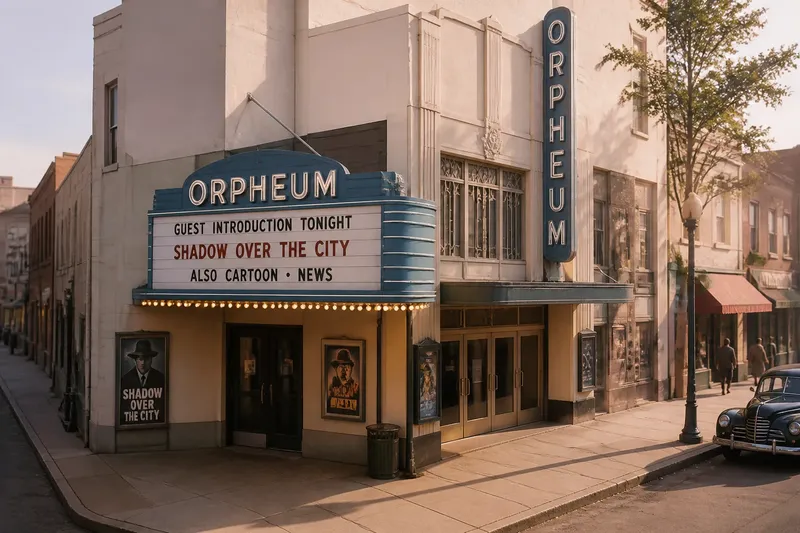
What can a cinema marquee tell you besides the film title? A cinema marquee can also show how a theatre marked its entrance, presented a particular program, and appeared within its street setting. Read the visible wording and placement together, and avoid treating one photograph as a record of every display the theatre used.
Entrance and approach
Begin with the doors. A marquee above an entrance can identify the way in, while a projecting canopy or a sign beside a recessed doorway may help make that approach visible from the sidewalk. The building’s layout matters: a marquee near one set of doors does not prove those doors served every visitor.
Trace a likely pedestrian route from the street to the threshold. Note which doors sit beneath or nearest the display, and whether another sign or entrance complicates the reading. This gives you a concrete basis for describing the marquee’s relationship to the entrance without assuming exactly how every visitor moved.
Say you are examining an invented photograph of the fictional Orpheum on a corner, with a marquee above a side doorway and a separate entrance on the main facade. You note that the sign is physically aligned with the side doorway, then compare the two entrances in the photograph. The resulting description can say that the marquee marks the side entrance; without further evidence, it should not claim that all patrons used it.
Record the doors and the sign’s position before interpreting its purpose.
Changeable wording
A marquee’s frame and its displayed message are different kinds of evidence. In a photograph, the frame, canopy, and mounting are visible as parts of the building; letters and notice panels may represent wording that could be changed. Do not assume every theatre used the same method or changed every line at once.
Transcribe each legible line separately. Distinguish a film title from a showtime, an additional attraction, or a short notice, and mark unclear letters as uncertain rather than filling them in from expectation. A photograph captures one arrangement, not a complete schedule of the theatre’s displays.
If a line appears blank or absent, several explanations may be possible, including a temporary display change or a photographic limitation. The image alone may not settle which explanation applies. Keep the observation separate from the interpretation.
Write down what is visible before deciding what changed.
Occasions and programs
Some marquee wording can identify an occasion as well as a film. A legible notice that names a live appearance, a special presentation, or a time-bound event supports the limited claim that the theatre was advertising that occasion. It does not establish attendance, audience response, or whether the announced event proceeded as planned.
Context is essential. A date, a readable line, or another view of the same display may help clarify what a notice refers to. Without that context, describe the visible words and avoid assigning them a specific event that the evidence does not identify.
Imagine an invented theatre photograph showing the words “Guest introduction tonight” above a film title. You transcribe both lines, note that the notice is positioned on the marquee, and leave the guest unnamed because the image supplies no name. The defensible result is that the display advertised an introduction that evening, not that a particular person appeared or drew a crowd.
Let the wording support the claim; do not make the claim larger than the wording.
Street and setting
A marquee also belongs to the streetscape around it. A projecting canopy, a vertical sign, or lettering mounted flat against a facade may be seen from different directions. Describe what the photograph shows: the sign’s position, nearby storefronts or buildings, and whether the display is visible from the depicted sidewalk.
Do not equate visual prominence with a proven effect on pedestrians. A marquee may stand out in an image, but that alone cannot tell you who noticed it or how people responded. Compare its placement with the surrounding buildings instead of judging it by letter size alone.
Look at the sign in relation to the block, not as an isolated object.
What can you tell from a marquee?
Does a marquee identify the main entrance?
It can show which entrance is nearest or directly beneath the display. Compare the sign’s position with all visible doors before describing it as the main entrance.
Can one photograph show how often wording changed?
No; one image records only the display visible at that moment. Look for dated images or other documentation before making a claim about how frequently the wording changed.
Does event wording prove an event took place?
It shows that the event was advertised, if the wording is legible and correctly interpreted. The display alone does not establish whether the event happened or how it was received.
How should unclear letters be handled?
Transcribe only the letters you can read and mark uncertain portions as unclear. Do not complete a word solely because a familiar title or phrase seems likely.
Evidence-based reading
Use this checklist to keep observations distinct from conclusions:
- Check the doors: If the marquee sits above or beside a visible entrance, describe that physical relationship; if no door is visible, avoid naming the entrance it served.
- Check the route: If the sidewalk and approach are shown, describe what is visible along that route; if they are cropped out, do not claim the sign guided pedestrians there.
- Check the fixed structure: If the canopy and mounting are clear, describe those features; if the image obscures them, leave their construction unspecified.
- Check each line of lettering: If a word is legible, transcribe it; if it is uncertain, mark it unclear instead of guessing.
- Check for event language: If the wording names an occasion, say it was advertised; if no occasion is named, describe the text without inferring one.
- Check the surrounding block: If nearby buildings and the sidewalk appear, explain the marquee’s visible setting; if they do not, avoid claims about its prominence in the street.
- Check the image date and source: If reliable context is available, use it to qualify your description; if it is missing, present the photograph as an undated or uncertain view rather than assigning a date.
For a clear account, start with what the image shows, then state what that evidence can support. The phrase “cinema marquee” may bring the title to mind, but its position, legible notices, and visible surroundings can make a more careful description useful.